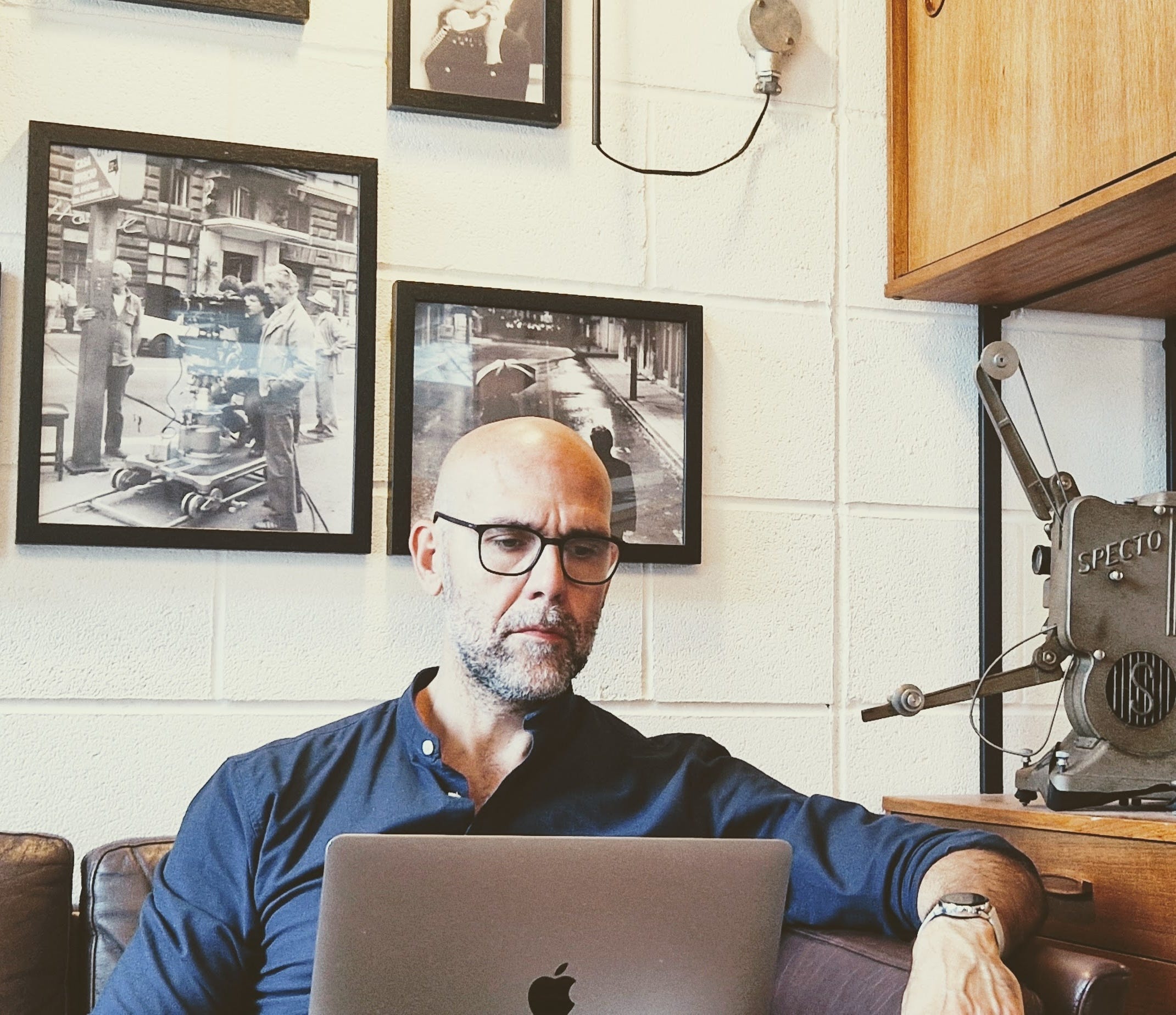
15 Questions With Dario Llinares, Writer
"My routine is to try to arrive at least an hour before the screening, drink a coffee, and work or read."
Name: Dario Llinares
Location: London
Occupation: Writer, podcaster, educator
Links: Dario’s Substack
1. What’s your favorite day & time to go to the movies?
Going to the cinema mid-afternoon on a weekday still has that slightly illicit thrill of escaping the working day. That said, with my mobile schedule, an intentionally curated film following a satisfying hour of writing at the cinema’s café is my usual routine. I often wonder what the other daytime patrons are escaping from. I love that feeling when you go into the cinema in the daytime, but when you come out, the shock of night hits you. It’s like another layer of time travel I associate with cinema.
At film festivals, I do perversely enjoy the 8:30 a.m. screening with a bunch of other caffeine-infused hacks who have burnt the candle at both ends for four days straight.
2. What’s your favorite movie theater?
As someone who writes about film through the prism of the auditorium experience, it’s impossible for me to select one cinema. Living in London, I’m spoiled for choice. And I’m going to make the pedantic distinction between specific auditoriums and the cinema overall as a coherent venue.
My favourite singular screening space is Barbican Screen 1. The raking angle is impressively steep, with the screen set a good five metres away from the first row. No matter where you sit, it’s a great viewing position. The space amalgamates the brutalist aura of the Barbican’s architecture, but it also has the enveloping quality of an old movie palace. They’ve also retained that lovely touch of opening and closing the curtains as the image comes up behind. I get such a charge of nostalgia when I see that; to me, it adds to a true cinematic aura.
In terms of overall venues, there are certain elements that have to coalesce. As I’ve already mentioned, my routine is to try to arrive at least an hour before the screening, drink a coffee, and work or read. So the café is also a consideration. Curzon Aldgate is something of a hidden gem and, even though it’s a newish cinema, they’ve done a great job with the design of the café. The screening rooms are all well designed, with great projection and sound.
Another regular haunt is the Garden Cinema, just on the cusp of Holborn and Covent Garden, which is perhaps the best overall cinema in London. It’s an intimate arthouse venue with three screens, an eclectic programme of films, seasons, and events, a thriving membership scene, and a cool downstairs bar in an art deco theme, with little cubbyholes almost designed for post-film discussion. At £10 a ticket in central London, the pricing is reasonable too.
I also must mention two cinemas on the south coast, which became regular haunts when I was working at the University of Brighton. The Kino Theatr opened the week I moved to St. Leonards. A gorgeous art gallery space with an adjoining restaurant. The cinema itself has been refurbished, maintaining the original brickwork. With a bar in the corner, the space easily doubles as a live event venue and has the feel of an old underground Jazz club.
Further along the coast in Hastings, there is the Electric Palace cinema. This is the epitome of a community-led, lo-fi venue sustained by the love and motivation of its volunteers. I staged several live episodes of The Cinematologists there and was always struck by the voracious debate among the cine-literate audience, most of whom were of the seasoned demographic. At the Q&A after a screening of La Notte, I had to mediate as too local ladies expand in thirsty detail of sexual frisson between Monica Vitti and Marcello Mastroianni.
Finally, I also have to mention the Kino International in Berlin. Even if I’m generally at the press screenings, this is a venue I always return to for at least one film. It’s striking as you walk up, standing imperiously away from the main road in brutalist resplendence (The exterior served as a backdrop to the cold war thriller Atomic Blonde). It’s a one-screen auditorium, which it oozes high-modernist glamour. Seeing something by Tarkovsky there would be a dream.
3. What’s your go-to movie theater snack & drink combo?
A Whisky Old Fashioned, with a portion of warmed chocolate brownie and vanilla ice cream, which they serve at Everyman Screen on the Green in Islington, is absolutely filthy. I basically have to fast for the whole day, to give myself the psychological permission to indulge.
4. What’s your dream movie theater snack & drink combo (if noise and sound weren’t an issue)?
See above. Cinemas need less food, not more (in the auditorium specifically). It’s always been a flaw in the model that exhibitors’ margins are so thin they have to push overpriced junk food just to make ends meet. I was once at a screening of Steve McQueen’s Hunger at the Hyde Park Picture House in Leeds. Behind me, through most of the film—including the extended scenes of an emaciated Bobby Sands (Michael Fassbender) on hunger strike—I could hear the ostentatious mastication of some guy wolfing down popcorn. Apart from being annoyingly distracting, the ridiculous irony of it made me question my faith in the immersive, transcendent effect of the auditorium experience.
5. First movie you remember seeing in a theater?
I have a dim memory of falling asleep quite early on in Star Wars, and waking up for the final space battle. This was 1977, I was four. I have a much stronger sense of seeing Superman a year later. At five, and clearly now with an emerging critical maturity, I remember being overwhelmed by the bombastic majesty of those opening credits. And the helicopter rescue scene is one of the great character introduction sequences in Hollywood history and a masterclass in continuity action editing.
6. Last movie you saw in a theater?
At the time of writing, it was Abbas Kiarostami’s double bill at the aptly named Close-Up Cinema. The two films were Bread and Alley (short) and A Wedding Suit. Both were exquist examples of the Iranian auteur’s mastery of cinematic storytelling. But in what was a grimly ironic evening, the host of the event—documentarian, film critic, and film curator Ehsan Khoshbakht—stoically introduced the films in the context of Kiarostami’s career and the themes he was preoccupied with during this period. With the devastating events currently unfolding in Iran, as we sat listening, the heaviness in the room was palpable.
7. Is there a movie you wish you could have seen in a theater?
My advocacy for the cinematic experience means I wish I could see all movies for the first time at the cinema. I don’t subscribe to the view that only certain spectacle-driven films require viewing in an auditorium. Even so-called smaller films are invested with a resonance that only happens in the cinema space.
The one film I would like to have wiped from my memory and watch again anew would be Leos Carax Holy Motors. Saw it at the Cornwall Film Festival in Newquay in 2011. It was the first screening of the week, and I emerged delirious into the multiplex foyer, me and probably 30 others trying to figure out what the hell we had just witnessed. I thought about its surreal brilliance for the rest of the event, every other film watched seeming bland and formulaic by comparison. Holy Motors is also a philosophical meta-commentary on the cinematic experience itself. It’s on my top ten list of greatest films of all time.
In terms of recent films, I recently watched Lucile Hadžihalilović’s The Ice Tower on BFIPlayer, and I wished I’d seen it on the big screen first; its baroque erotic vampirism, exploring the surreal mechanics of filmic illusion, really demanded the grandeur of a big screen.
8. Have you ever seen a movie more than once in theaters?
Too many to mention. I probably go to rep screening as much as new releases. I’ve probably seen 2001: A Space Odyssey and Blade Runner 4-5 times over the different format releases. Last year I saw One Battle After Another 4 times and Sentimental Value 3 times with different friends and because I wanted to write about the films.
9. Do you stay through the credits or leave once the film ends?
I’m not religious about this; I’ve always found it a little performative. If the film has moved me and I want to take a bit of time to reflect, I’ll stay. If I have somewhere I need to be, for example at festivals when you need to get to another screening, I don’t hang around. I don’t tend to watch films that have post-credit easter eggs either.
10. What’s one thing you would change to make movie theaters better?
I’ll refrain from stepping into the minefield of “managing audiences” with this one, which I know is the number one concern for so many regular filmgoers. Living in London, I do have the option of frequenting fantastic cinemas that, in terms of space and service, offer a great experience. To me, across the board, it’s about “the two Ps”: Price and Programming. If you look at the research, price is the main concern for a swathe of the potential audience, so finding unique ways to discount and draw audiences in at off-peak times, etc., is very important. With programming, it’s clear cinemas have to show what audiences will come to see. The multiplex era, where half the screens are overtaken by one blockbuster, thankfully seems to be coming to an end.
Cinemas need to be more flexible, innovative, and responsible for preserving film culture. Sophie Katsali’s notion of cinemas as cultural gyms is an interesting provocation. I’ve written about the responsibility of cinemas for film education. One has to acknowledge, though, the fact that cinemas (particularly independent ones) are under tremendous pressure to simply stay afloat. A lot of indie cinemas leaned into the Barbenheimer phenomenon a couple of years ago, at the expense of a more eclectic programme, and you can’t blame them.
As much as cinemas can improve, audiences need to be better too. Choosing to support a cinema through the effort of regular attendance (and potentially extras like a membership) rather than streaming is a form of deliberate cultural advocacy that, if you consider yourself a lover of film and you have the means, you should see as your duty.
11. Tell me about an especially memorable moviegoing experience that stands out in your mind.
There are so many, and in myriad different ways.
The first time I saw Jean-Luc Godard’s Pierrot le Fou was at Sheffield’s Showroom as part of my university degree. It was a life-changing experience. It returned my sense of what cinema was and could be.
Years later, now an experienced lecturer, we watched David Lowery’s A Ghost Story with a group of students in Falmouth University’s screening room. This was for a Cinematologists podcast live taping, and the post-film discussion turned into a kind of cathartic group reflection on the nature of existence (and you can listen to the episode here).
Apichatpong Weerasethakul’s Memoria, which I saw at FilmHaus, Berlin, was incredible to me. I was thinking about the relationship between sound and immersiveness in cinema at the time, and this went from a strange theatrical art-house curio to a question of the human basis of reality, to opening reflections on cosmic resonance. Also, at Berlin, being with my friend Mark Jenkin for a packed screening of his brilliant Bait, the moment his career actually took off was quite surreal.
It was also pretty intense when I went to see Interview with the Vampire at the Showcase near Leeds with my then-girlfriend. She fainted in her chair and started convulsing during the scene where Cruise cuts his wrists and bleeds all over Brad Pitt’s face. Even before the bloody homoeroticism could register, I had to carry her out into the foyer and ask the staff to call an ambulance. I spent the rest of the afternoon in A&E. She was fine in the end. As we were leaving, the nurse said to us with a wry weariness, “That’s the third one this week.”
12. What’s a movie you’re looking forward to seeing?
There are many films from directors I love coming out this year. As is increasingly the case, though, even filmmakers who have had critical/festival success in the past have no guarantee of distribution. Here are three: All of a Sudden (Ryusuke Hamaguchi); The Entertainment System Is Down (Ruben Östlund); My Wife Cries (Angela Schanelec).
In terms of big mainstream stuff, Dune 3, I’m looking forward to for sure. Dune 2 was an amazing visual and visceral experience, and the next book in the series takes place in space and gets even crazier than the first. I don’t know how Denis Villeneuve is going to do it, but I’ll be visiting the BFI IMAX in opening week to find out.
13. What’s your dream combination of director and lead(s)?
I know Michael Mann is coming back to make Heat 2 with a stacked cast. But I always wanted to see something in the Mann style with Denzel Washington. Some kind of social context crime thriller with Washington toning it down a little in the service of a stripped-back, psychological story. I’m looking forward to seeing what Iñárritu does with Tom Cruise in the upcoming film Digger.
My girlfriend just shouted PTA with Mahershala Ali, which is a great pick.
14. If you could live in a movie, which one would it be?
At the risk of getting pretentiously meta, I would probably go for something set in an impossibly romanticised European city in the summer. I know Woody Allen is all levels of problematic, but I loved Midnight in Paris. Owen Wilson’s struggling writer gets to time-travel to different periods in the French capital’s mythological artistic past. Writing an opus in the morning before partying with Hemingway, Zelda and Scott, getting literary feedback from Gertrude Stein, drinking chartreuse with Man Ray and Dali in a Left Bank café, and walking home with Marion Cottilard.
15. Why do you think people should continue seeing movies at the movie theater?
Answering this question is basically the main driving force behind my Substack work as a whole. I’m also a realist. The notion that movie-going was the central pillar of media-culture experience, as it had been from the early to the late 20th century, is wishful thinking. Indeed, I would say that the democratisation of access to film has been important. I’m also fully cognisant of the problems of access to cinemas, when talking generally about price, or the fact that it can’t be taken for granted that everyone actually has a cinema in close proximity.
Streaming does open access; however, the algorithmic tyranny of the tech companies and their hyper-consumerist logic have, in reality, narrowed creative diversity in film distribution while actively undermining the value of the theatrical experience. Furthermore, the forms of production and the platformisation of attention have trained a kind of semi-distracted, dopamine-overdosed mode of zombified screen engagement.
What needs to happen is a reframing of the value of the theatrical experience from the standpoint of both filmmaking and film watching. The many filmmakers who are coalescing around the idea of NonDē (coined by Ted Hope) are, thankfully, putting theatrical exhibition at the centre of their efforts to build a new kind of relationship with audiences: building networks of friendly independent cinemas and creating a new culture of microcinemas.
I think reasserting what is meant by the collective experience is also vital. This, for me, is less about going to a venue with a group of your mates. I go to the cinema alone most of the time, and, as I’ve written about here, try to maximise the possibility for immersion without the myriad infernal distractions that so many regular filmgoers lament. But there is something still unique about the sharing of experience, where individual embodied subjectivities are simultaneously transported into another dimension.
I agree with film theorist Martine Beugnet, who writes:
“Only in the presence of a cinema screen do the conditions of reception (a collective audience watching a collective character or characters as a collective) allow for a form of performative, collective identification—as, and with, a crowd or a group of people occupying space”
- “The Bigger Picture: On Watching Films on the Cinema Screen.” In Hanich & Rossow (2023), What Film Is Good For. University of California Press.
In another vein, there is an opportunity to frame theatrical viewing as part of a renaissance of the present: a way to reintegrate with your embodied attention to, and resonance with, the world. Like vinyl listening parties, note-taking with pen and paper, using a Polaroid camera, or simply leaving your phone at home to go for a walk, cinema could be a kind of refuge from digital insistence.
I realise the irony here, because we’re talking about looking at a screen. But the fundamental apparatus—or, to use the more precise French term, “dispositif”—manifests a unique set of conditions that encourage a different quality of looking: one anchored in duration, in shared stillness, and in the relinquishing of choice. You can’t pause, you can’t skim, and though you can look away or leave, there is a demand to practise a state of being and contemplating.
You willingly submit to the film’s tempo, and in doing so, you submit, briefly, to the dynamics of your own attention: how it wanders, how it locks in, how it resists being managed. Paradoxically, cinema is not passive in the way doomscrolling is. The auditorium doesn’t just show a film; it stages an encounter with time rather than stealing it.
And finally, quite simply, the rescaling of the image manifests an expansiveness that offers the possibility of the sublime. That feeling of being overwhelmed by sheer scale, where we feel helpless in the face of vastness yet are ultimately imbued with a kind of pleasure in confronting such power. There can’t be any comparison between the experience of a film on the big screen and a TV, a laptop, let alone a phone.
All of these can show you films, but none are cinema.